
For whom the hour strikes
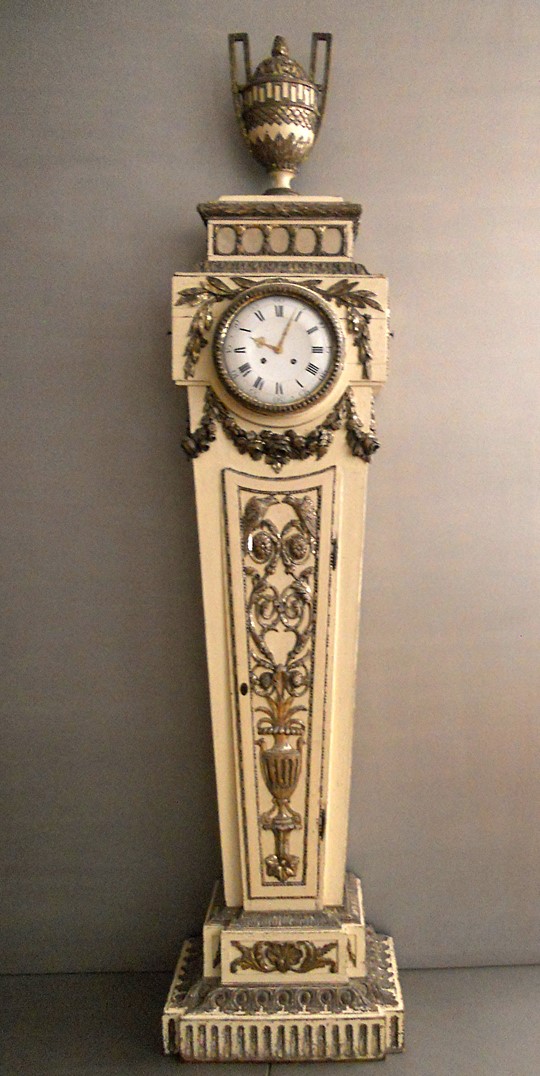
This vestibule grandfather clock was acquired in 1934 and has since been held by the Museum of Applied Art (known at the time as the Museum of Decorative Arts).
The word “vestibule” comes from the Latin term vestibulum, meaning “forecourt”. In 18th- and 19th-century architecture, a vestibule referred to distinguished entrance halls in grand homes, reminiscent of the antechambers in ancient Roman villas.
The clock’s provenance is uncertain. It was initially believed that Nicholas Pigage from Mannheim designed the grandfather clock in the 1770s, as the ornamental designs on the clock bear a striking similarity to the Frenchman’s other works for the Palatine Elector Karl Theodor, but this idea was dismissed due to stylistic differences. It’s more likely that the clock was made by Carl Ludwig Bauer in 1792/95. He had adorned the King’s Chambers of the destroyed Berlin Palace for Friedrich Wilhelm II with the same, typical leaf tendrils that can be seen on the clock.
Clocks from Berlin and Potsdam were known for their lavish design. The grandfather clock is an example of Classicism, which came into fashion after Friedrich Wilhelm II’s ascension to power in 1786. This also had an influence on the nobility and the emerging upper class. They especially borrowed from the Classicism movement in the design of their villas. The silver-coated moulding on the clock’s body is nothing new: Friedrich II, uncle and predecessor of Friedrich Wilhelm II, had the walls and ceilings in his Schloss Sanssouci decorated in the same manner. White-painted pine wood was the sole material used for this purpose.
But the real treasure can be found inside the clock itself: the flute mechanism. It comprises 31 wooden flutes, activated by a wooden roller with pins that operate sensing levers with wooden push rods. There are three bellows at the bottom of the musical mechanism. And the music itself isn’t bad, either: It plays a mix of songs from Mozart’s Magic Flute.