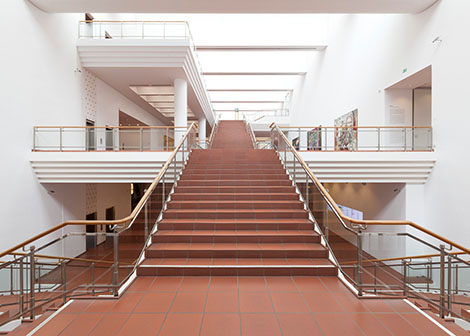
Ludwig Museum
The Ludwig Museum has the most extensive Pop Art collection in Europe, the third largest Picasso collection in the world, one of the best collections of German Expressionism, and one of the leading collections of photography. The museum's foundation is based on a generous donation by Peter and Irene Ludwig to the city of Cologne.
Visit information
Heinrich-Böll-Platz
50667 Köln
Website: www.museum-ludwig.de
Facebook: https://www.facebook.com/MuseumLudwigKoeln
Instagram: https://www.instagram.com/MuseumLudwig/
Directions & Transportation
Public transport
Train, S-Bahn (from the airport): "Hauptbahnhof" (main station)
Bus, subway, streetcar: "Dom/Hauptbahnhof" (main station)
Parking
At the Cathedral/Philharmonic/Gross St. Martin
Ludwig im Museum
Tue – Sun 10:00 – 24:00
+49 221 16875139
www.ludwig-im-museum.de
Buchhandlung Walther König in the Ludwig Museum, catalogue sale, art shop, postcards, art literature
+49 221 2059635
www.buchhandlung-walther-koenig.de
Freunde des Wallraf-RichartzMuseum und des Museum Ludwig e.V.
museumsfreunde-koeln.de
Society for Modern Art at the Ludwig Museum
gesellschaft-museum-ludwig.de/
What do Warhol, Beuys and Picasso have in common? They are housed in the Ludwig Museum. The building on the Bischofsgartenstrasse, located near the Cologne Cathedral and the Hauptbahnhof, counts as one of the most important art museums in Europe. Founded in 1976 when the married collector couple, Peter and Irene Ludwig, donated 350 works of modern art to the city of Cologne, including the most extensive collection of American pop art outside the United States that was revolutionary in its time. There is no end to the superlatives: After Barcelona and Paris, the Ludwig Museum has the third-largest Picasso collection in the world, one of the most important collections of German expressionism, prominent works of the Russian avant-garde, and an excellent selection on the history of photography. In addition, an overview of the most important art movements and media of the 20th century, contemporary art up to the present and important artists from Rhineland – Gerhard Richter, Sigmar Polke and Martin Kippenberger. The global nature of the ever-growing collection of the Ludwig Museum will become still more pronounced with artists from Africa, Asia and Latin America.
»Current questions on cultural origin and identity, but also sustainability and climate protection, are relevant themes for us at the Ludwig Museum, which we would like to make accessible to our public. Even in times of crises, art is more important than ever as a meaningful element.«
– Yilmaz Dziewior, Director of the Ludwig Museum Cologne
August & Marta
A bob, the blouse askew, and various symbols on the cheek. This is how the painter, Marta Hegemann (1894 –1970), posed for the camera. In the 1920s, together with her artist husband Anton Räderscheidt, she was one of the most enigmatic figures of the Cologne cultural scene. Whoever considered themselves Dadaist and progressive met in the shared residential studio at Hildeboldplatz No. 9. They painted, caroused and held discussions all night long. Hegemann’s pictures show the type of modern woman whom she herself embodied: self-confident, non-conformist. And Hegemann, a trained teacher, again and again also dealt with children – or being a child? For the “Raum und Wandbild” (Room and Mural) exhibition (1929 in the Kölnischer Kunstverein), two huge murals were created for a child’s room. The photographer, August Sander, photographed not only the artist, but also her two pictures which are lost even to this day.
No party without Warhol
No party without Andy. Warhol was able to ennoble every vernissage, every trendy event with his presence. And where he could not be present personally, he sometimes sent a doppelganger. The pop artist, world-famous for his Marilyns, Campbell’s soup cans, and Coca Cola bottles, obsessively sought out the beautiful and the influential. And remained strangely aloof from everyone and everything – the enraptured gaze, the absent grin, the silence, broken occasionally by a banal “Oh, great!”. The corpse-like complexion, the sunglasses, the snow-white dyed hair. Warhol loved the staging as an inscrutable art figure, it made the man beset with fears and complexes into one of those dazzling stars whom he himself so worshipped, and – not least – increased the market value of his works. Only a few managed to glimpse behind the scenes of the perpetual Warhol Show during the artist’s lifetime – at the timid boy, the family man, the migrant, the homosexual, the Sunday churchgoer.
Texts: Rüdiger Müller